
Search Arkansas Deed Records
Arkansas deed records are filed and kept at the county level through the Circuit Court Clerk's office in each of the state's 75 counties. There is no single statewide deed database. Each county maintains its own set of property transfer documents, including warranty deeds, quitclaim deeds, mortgages, liens, plats, and related instruments. To search deed records in Arkansas, you contact the Circuit Clerk in the county where the property sits. Some counties offer online access through their own portals or through state-linked tools. Others require an in-person visit or a written mail request to get copies.
Arkansas Deed Records Overview
How Arkansas Deed Records Work
Arkansas runs a county-level recording system. Every deed, mortgage, or other instrument that affects title to real property must be filed with the Circuit Clerk in the county where the land sits. The Circuit Clerk serves as the ex-officio county recorder by state law. That office records the document, assigns a book and page or instrument number, and keeps it as part of the public record. Under Arkansas Code § 14-15-404, a recorded instrument gives constructive notice to all future buyers and lenders from the moment it is filed. This is why recording at closing matters so much.
Arkansas is a race-notice recording state. That means the buyer who records a deed first, without knowledge of a prior unrecorded transfer, generally wins a title dispute. No deed made after December 21, 1846 is valid against a later buyer who pays value and lacks actual notice, unless that earlier deed was duly recorded. Title companies and attorneys advise clients to record the same day or within days of signing. Delays in recording create gaps that can invite competing claims.
Under Arkansas Code § 14-15-402, the county recorder must record all deeds, mortgages, conveyances, deeds of trust, bonds, and similar instruments in the proper books kept for that purpose. The clerk indexes each document by grantor name and grantee name. This lets you search the chain of title forward or backward from any owner's name. Some clerks also index by legal description, though this varies by county.
Not every county has an online system. Smaller counties often only offer in-person access at the courthouse. Larger counties such as Pulaski, Benton, and Washington have modern web portals where you can search records by name, instrument type, or date range without leaving home.
Where to Find Arkansas Deed Records
The Circuit Clerk's office in each county is the main source for deed records. Every county has one. The office holds deeds, mortgages, liens, plats, powers of attorney, and related instruments going back to when that county was formed. Office hours are typically Monday through Friday, 8:00 AM to 4:30 PM, though a few smaller counties close for lunch. You can visit in person, send a written mail request, or in many cases use an online portal. Always call first to confirm hours and procedures before making a trip.
The Arkansas Commissioner of State Lands handles a separate but related set of records. The COSL oversees tax-delinquent property. When real estate taxes go unpaid for one year, the county tax collector can certify that property to the Land Commissioner. The Commissioner sends notice to the owner and any known lien holders, then sells the property at public auction. Buyers receive a limited warranty deed. The COSL also keeps parcel maps and past auction results as research tools. If you are looking at a property that may have tax issues, the COSL is a critical resource.
The Arkansas State Land Surveyor's Office maintains General Land Office notes, plats, and corner certificates. Their online plat retrieval tool lets you look up survey documents by location. This is useful when you need to verify a legal description or research the original survey of an older parcel.
For business entities that hold Arkansas real property, the Arkansas Secretary of State Business and Commercial Services Division can issue certified copies of entity records. Those copies may be needed in court proceedings or transactions involving land held by an LLC, corporation, or trust.
The Commissioner of State Lands site below shows the full scope of Arkansas tax delinquent property resources, including auction schedules and parcel maps that supplement county deed indexes.
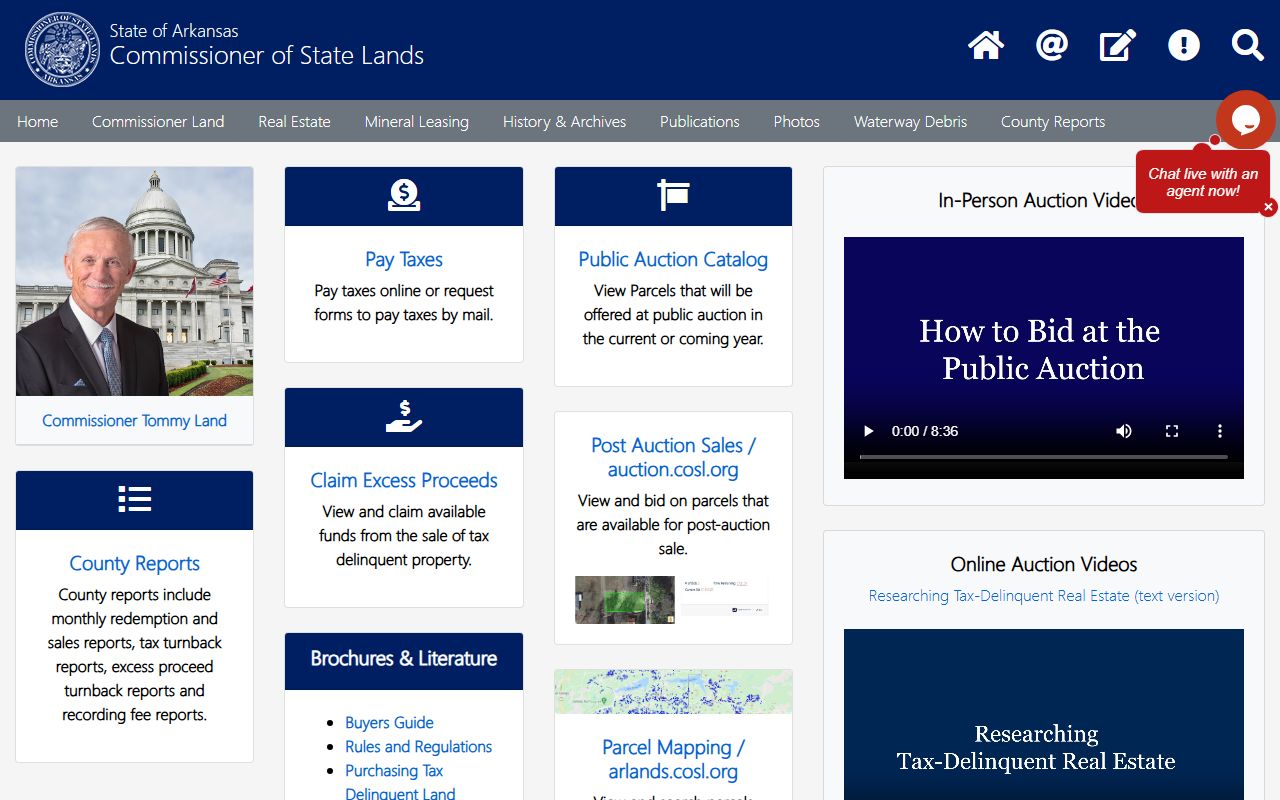
The COSL website covers tax-delinquent properties across all 75 Arkansas counties and lets you browse parcel maps alongside past auction results.
Searching Arkansas Deed Records Online
Several tools make it possible to search Arkansas deed records without driving to a courthouse. The most widely used state-linked aggregator is ARCountyData. This tool pulls property and land record information from county assessors and clerks across Arkansas. Many county assessors sponsor access at no charge, so searching is often free. You can look up records by owner name, parcel number, or property address. Coverage and image availability vary by county, but it is a strong starting point for most searches.
The Arkansas Judiciary Case Search focuses on court cases rather than deed instruments, but it is important when checking for judicial foreclosures, judgments that became liens on real property, or probate proceedings involving a property transfer. These case records directly affect title and show up in any thorough title search. The tool is free and covers circuit court cases across most counties in the state.
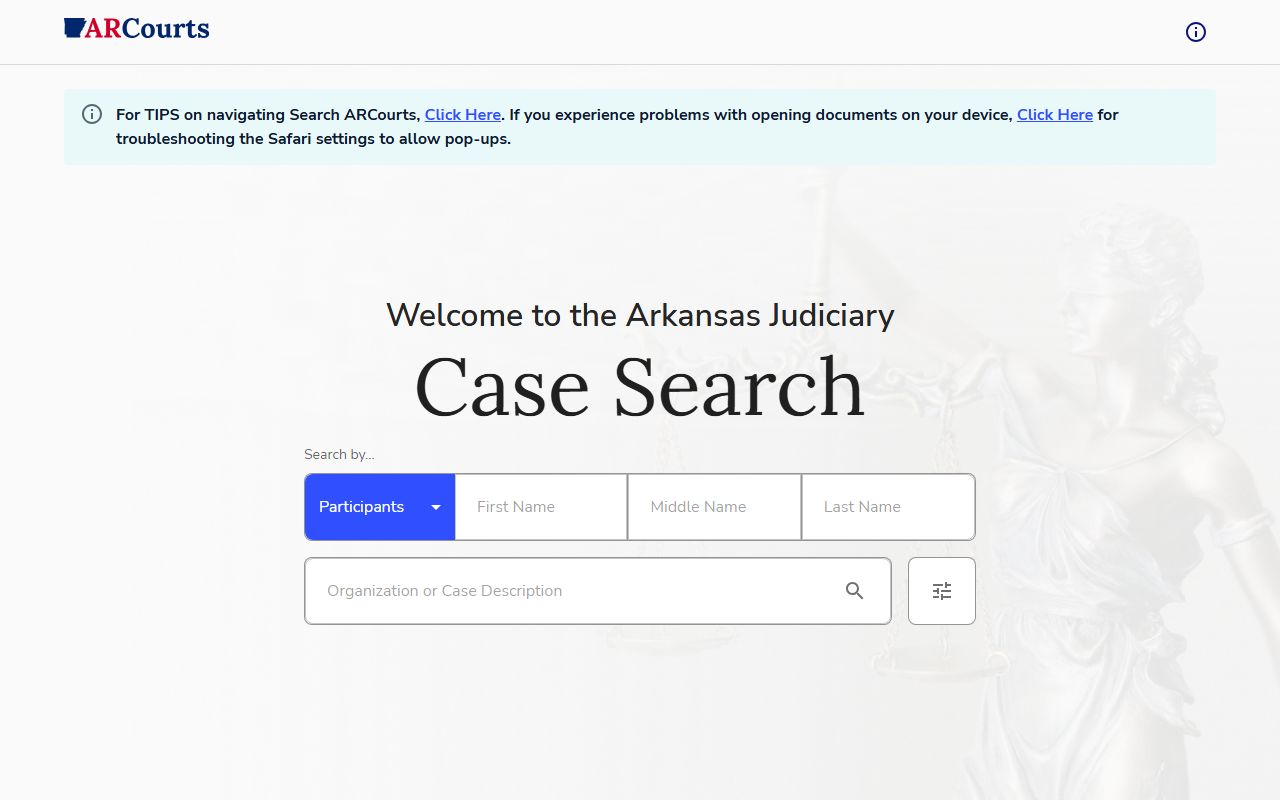
The Arkansas Judiciary Case Search is free to use and supplements deed index searches when you need to check for judgment liens or foreclosure actions that could cloud title to a property.
Some counties use ActDataScout as their public land records portal. This platform gives searchable access to recorded instruments, including deed images, for the counties that subscribe to it. Garland, Pope, Lafayette, Izard, Phillips, Union, and several other Arkansas counties are accessible through ActDataScout. Other counties use Titlesearcher.com, CountyService.net, or their own custom portals. The best first step is to go to the specific county page on this site to find the right tool for that county.
The Arkansas Secretary of State corporation search is useful when an LLC, partnership, or corporation shows up as grantor or grantee in a deed. You can confirm the entity's name, registered agent, and good standing status quickly through this free tool.
Arkansas Deed Recording Requirements
All deeds submitted for recording in Arkansas must meet formatting rules under Arkansas Code § 14-15-403. The document must be on 8.5 by 11 inch paper. The first page must have a 2.5-inch blank margin at the top right corner, reserved for the recorder's stamp. Side and bottom margins must be at least half an inch. The last page must have a 2.5-inch blank margin at the bottom. Documents that don't meet these standards may be returned unfiled or assessed a non-standard document fee in some counties.
The first page of every Arkansas deed must include the title of the document, the grantor's name, the grantee's name, and the name and address of the person who prepared it. When a deed is recorded, the county recorder must also obtain the grantee's mailing address for future tax statements per Arkansas Code § 26-26-709. This address goes on file so that tax statements can be sent to the new owner after the transfer is recorded.
Deeds must be signed in the presence of two disinterested witnesses or acknowledged before a notary public under Arkansas Code § 18-12-104. When the property being conveyed is a homestead, both spouses must join in signing the deed. Arkansas homestead protection provisions prevent one spouse from conveying a primary residence without the other's agreement. This protection is tied to the Arkansas Constitution and does not depend on whether both names appear on the title.
Note: Starting August 5, 2025, anyone filing a deed in Arkansas must present a valid photo ID under Act 752. Exemptions apply to licensed attorneys, real estate brokers, bank representatives, and government employees acting in their official capacity.
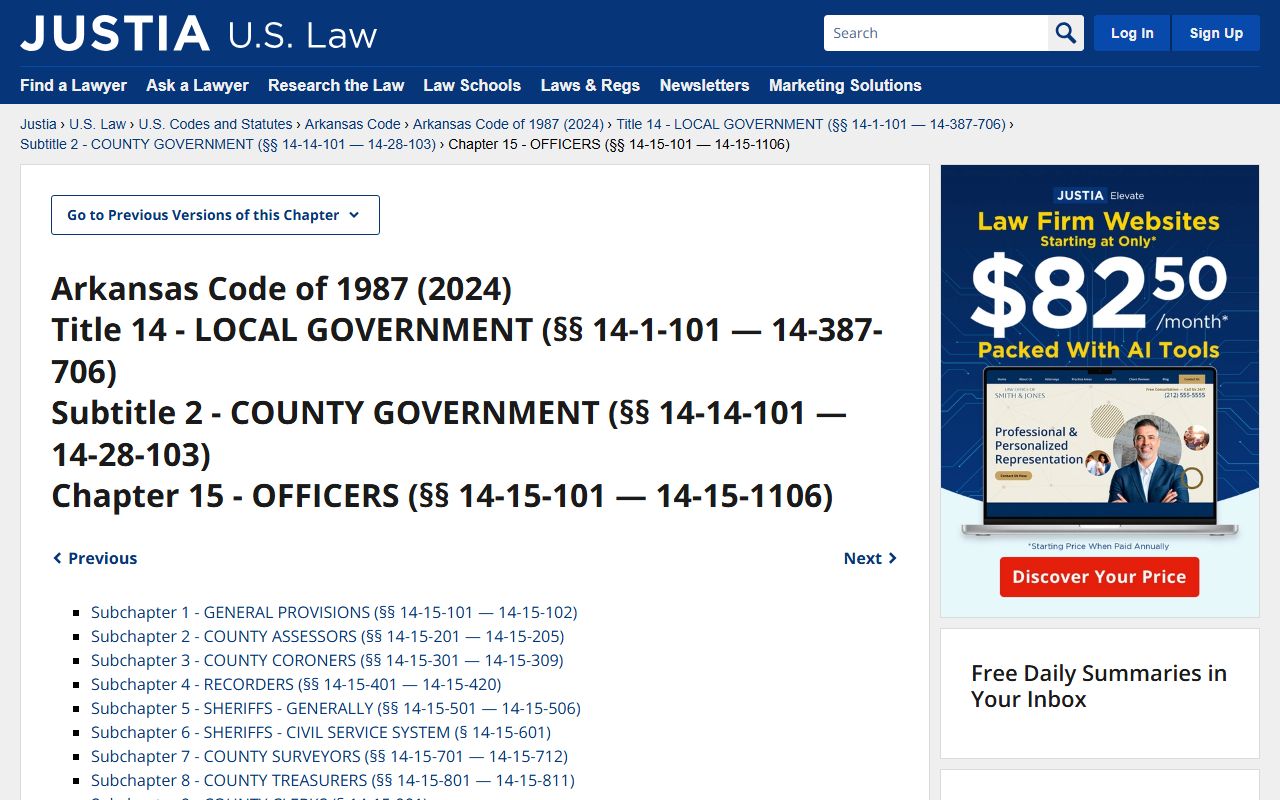
The Arkansas recording statutes in Title 14, Chapter 15 cover the full set of rules around deed formatting, the recorder's duties, and how instruments give constructive notice to third parties once filed.
Deed Recording Fees in Arkansas
Recording fees in Arkansas follow the schedule in Arkansas Code § 21-6-306. The standard rate is $15 for the first page and $5 for each additional page. This applies to deeds, deeds of trust, mortgages, releases, powers of attorney, plats, survey plats, notary bonds, foreign judgments, and a range of other recorded instruments. A two-sided document counts as two pages. If a single document contains multiple instruments, each additional instrument may carry its own $15 base fee.
Arkansas also collects a Real Property Transfer Tax on most property sales. The rate is $3.30 per $1,000 of consideration on any transaction above $100. The clerk collects this tax at the time of recording. Common exemptions include gifts between close family members, transfers between spouses, transfers to or from a living trust, and certain divorce-related transfers of property. The clerk stamps and indexes the deed once both the recording fee and the transfer tax have been paid.
Copies of recorded documents have their own fee structure. Most counties charge between $0.25 and $0.50 per page for plain copies and $5.00 for a certified copy. In Benton County, regular copies run $0.25 per page and certified copies cost $5.00. Full-size plat copies there run $3.00 per page. Fees vary slightly across counties, so checking the specific county's Circuit Clerk website before submitting a request saves time.
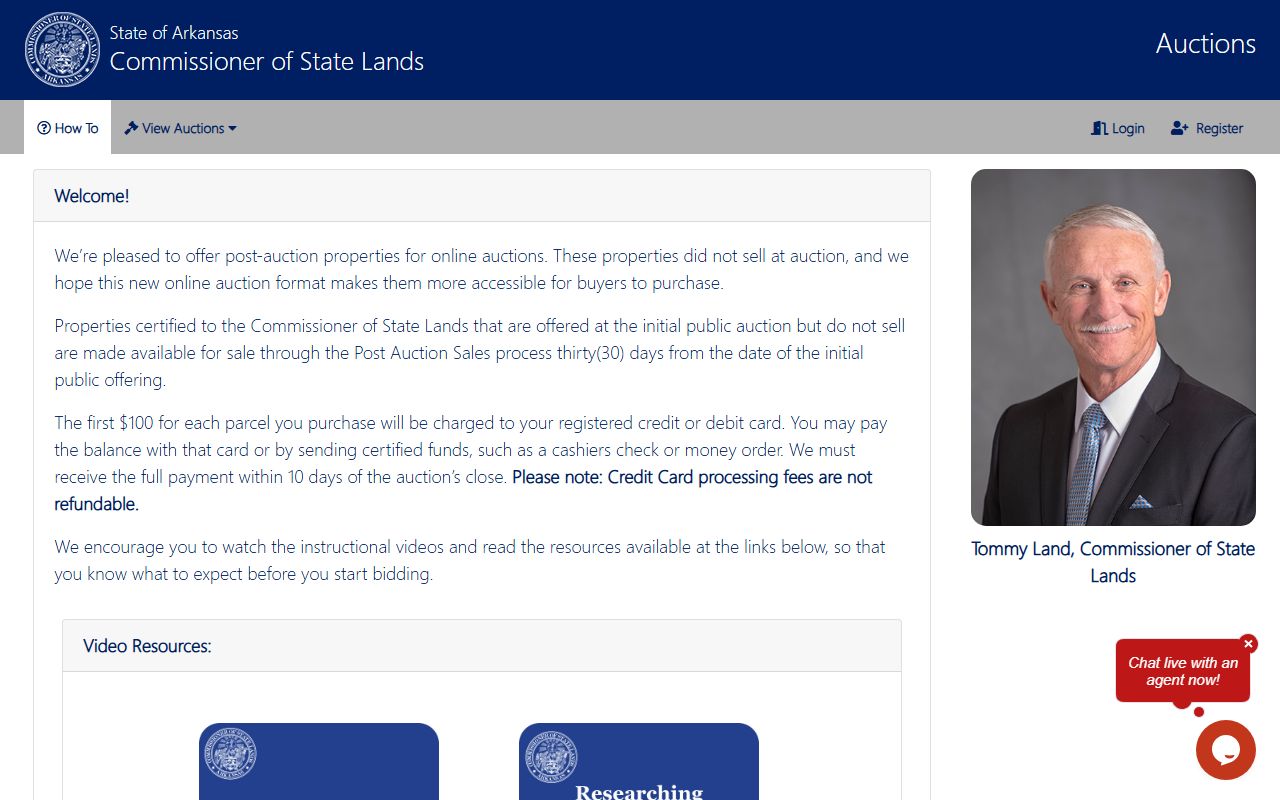
Tax delinquent property auctions in Arkansas run through the COSL online auction platform. Winning bidders at these auctions receive a limited warranty deed from the Commissioner of State Lands.
Electronic Filing of Arkansas Deed Records
Arkansas allows electronic recording of real property documents under Arkansas Code § 14-2-301 et seq., the Uniform Real Property Electronic Recording Act. Most counties now accept e-filed documents through one or more approved vendors. The four main vendors used in Arkansas are CSC eRecording Solutions (1-855-200-1150), Simplifile (1-800-460-5657), eRecording Partners Network (1-888-325-3365), and Indecomm Global Services (1-877-272-5250). Title companies and attorneys routinely use these services for fast, same-day recording without driving to the courthouse.
Electronic filing does not change the content requirements for the deed. The document must still meet formatting rules, include the required margins, and be properly signed before a notary or two witnesses. Once a clerk accepts an e-filed document, it is considered filed of record the same as a paper original. Many counties that previously required in-person submission now accept e-recording through at least one of these vendors.
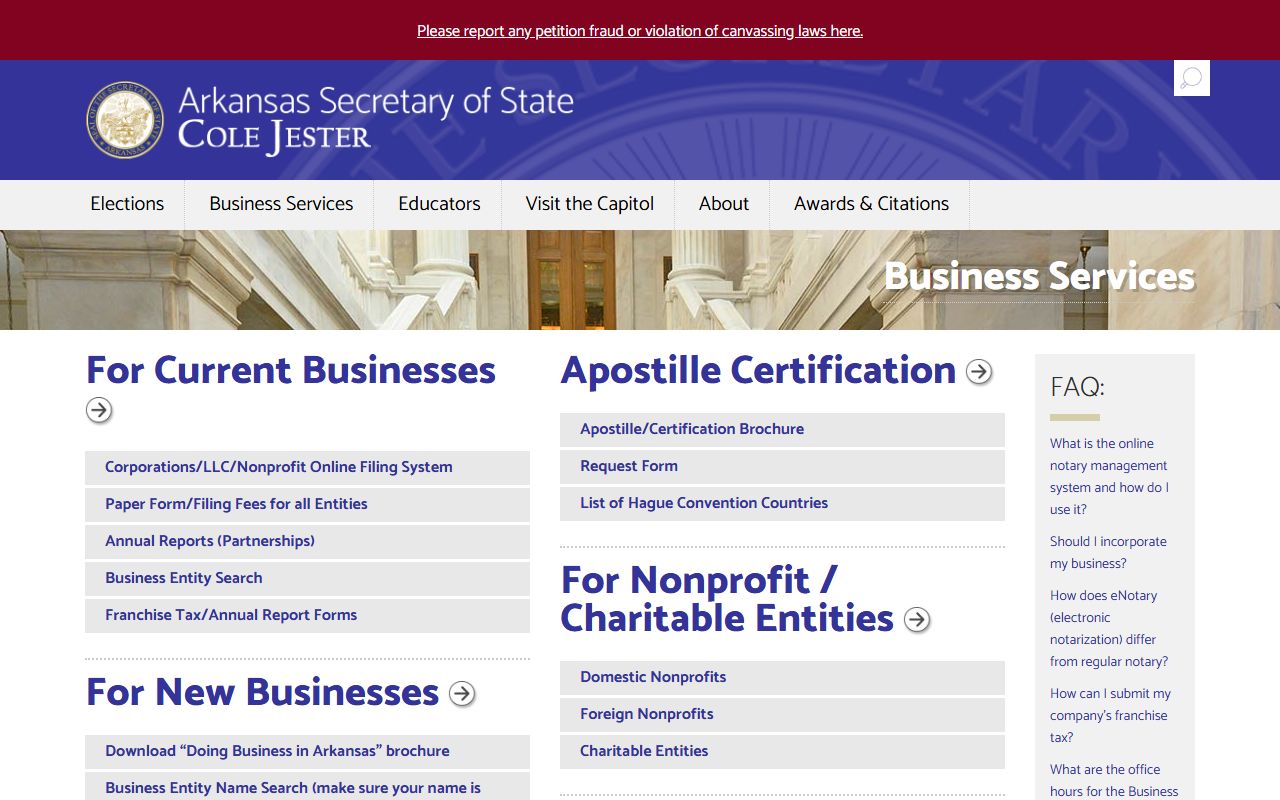
The Arkansas Secretary of State issues certified copies of entity records that are often needed in real property transactions involving companies, LLCs, or trusts that hold title to Arkansas land.
Arkansas Plat Records and Land Surveys
Plat records document the formal division of land into lots and subdivisions. Under Arkansas Code § 14-18-101, once a surveyor certifies a plat it must be filed with the county recorder of deeds and a copy goes to the county assessor. The Circuit Clerk keeps the official plat books. Each new subdivision or replat adds to this record. Plats are critical when verifying lot boundaries, easements, or the legal description tied to a specific address. Without a recorded plat, a parcel may not have a clear legal description at all.
The Arkansas State Land Surveyor's Office maintains General Land Office notes, corner certificates, and historical survey plats going back to the original government surveys of Arkansas land. The office runs an online plat retrieval tool at www.plat.arkansas.gov for public access. For highway right-of-way records acquired since the early 1990s, the Arkansas Department of Transportation maintains survey worksheets. You can reach the DOT Land Surveys Division at 501-569-2385 for those records.
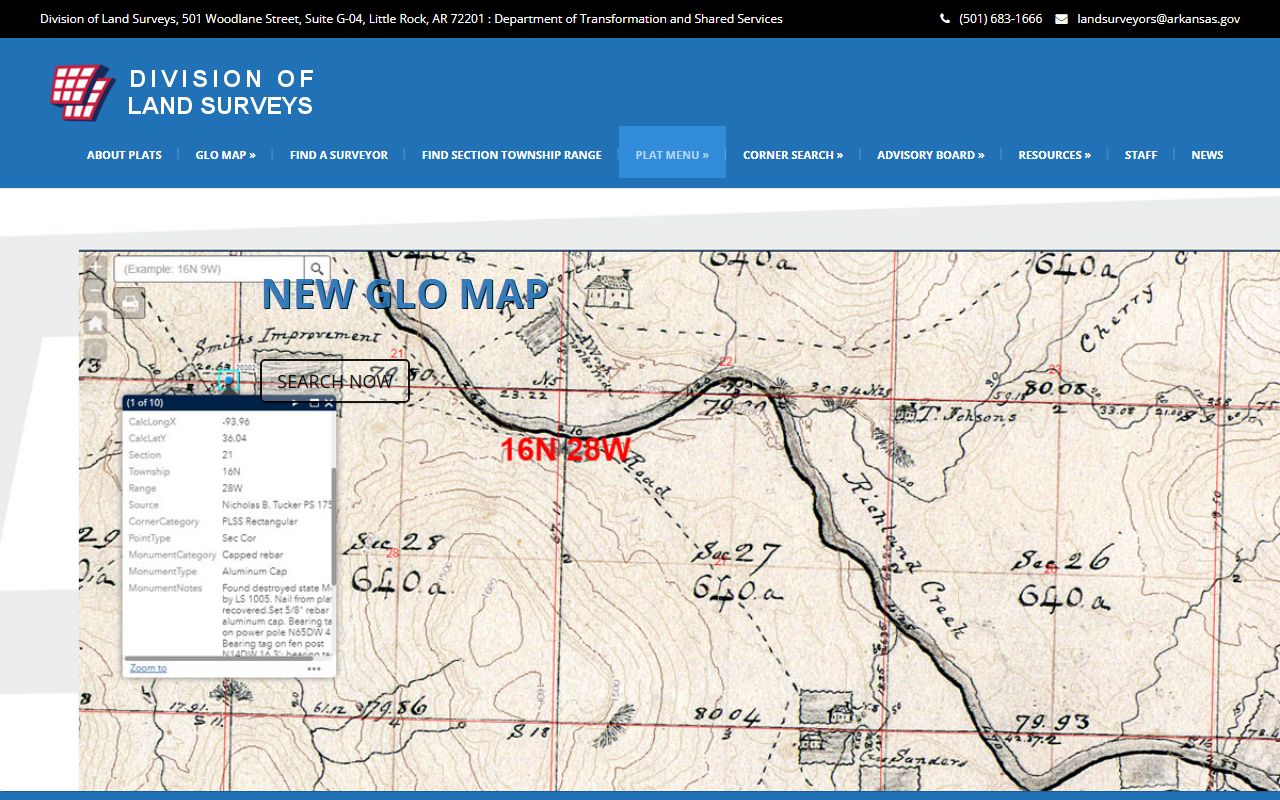
The Arkansas State Land Surveyor site gives access to historical plats, corner certificates, and survey worksheets that supplement county deed indexes when researching legal descriptions and boundary information.
Historical Arkansas Deed Records
For older deed records, the Arkansas State Archives and its Digital Archives program hold digitized collections including land donation applications, swamp land applications and patents, proof of internal improvement papers, forfeited deeds, and relinquishment papers. These collections let researchers trace land ownership back to the territorial period. Two regional archive centers extend this reach: the Northeast Arkansas Regional Archives serves a 16-county area, and the Southwest Arkansas Regional Archives covers 12 counties in the south and southwest parts of the state.
Many Arkansas counties have older deed records through FamilySearch.org, which has digitized deed books, mortgage indexes, and surveyor records going back to the mid-1800s. The depth of these records varies by county. Some collections go back to the 1840s and 1850s. Others are more limited. A few counties suffered courthouse fires that destroyed early records entirely. Clay County, for example, lost deed records from December 1875 through February 1893 in a fire at the Piggott courthouse. Knowing a county's record history helps when a title search turns up gaps.
The Arkansas Department of Finance and Administration also plays a supporting role in property records through its Revenue Division, which manages assessments and oversees county tax data statewide.
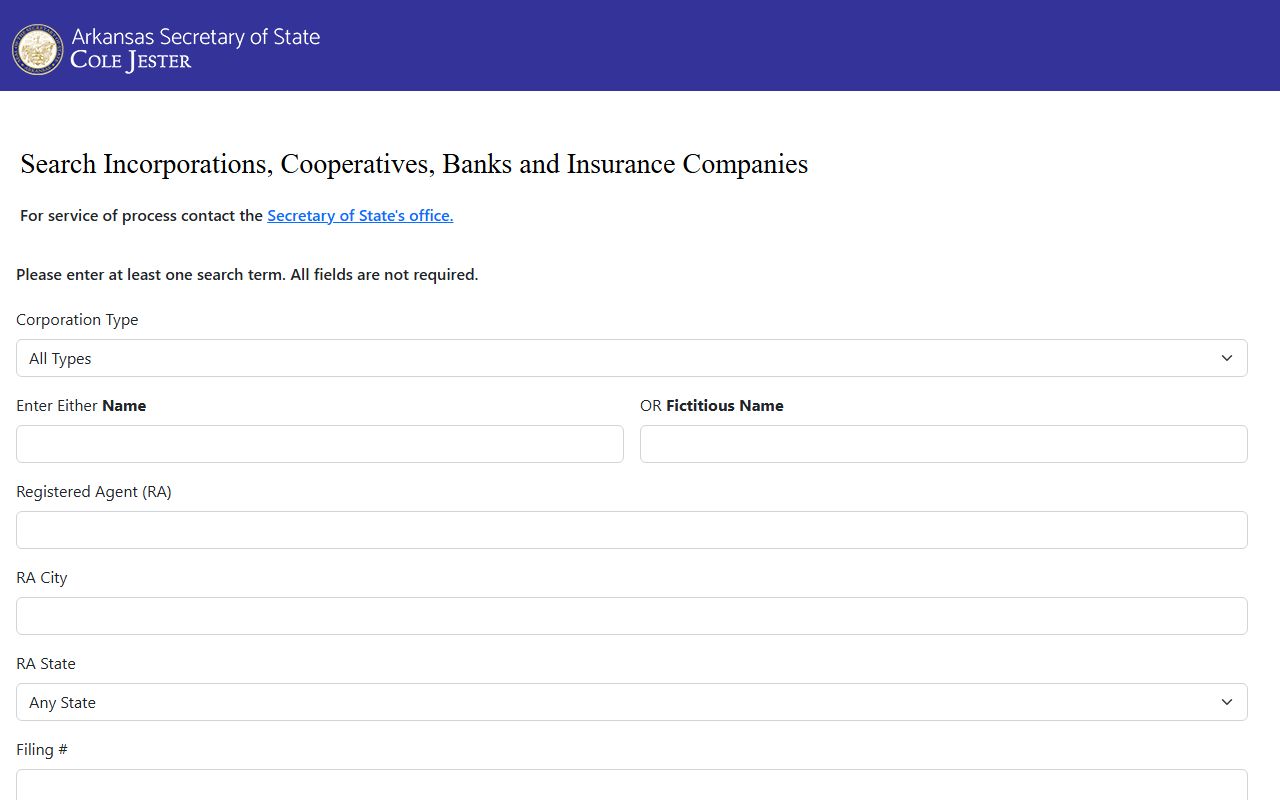
Entities listed as grantor or grantee in Arkansas deed records can be verified through the Arkansas Secretary of State corporation search, a free tool that confirms the legal name and standing of businesses holding title to property.
Browse Arkansas Deed Records by County
Deed records in Arkansas are maintained at the county level. Each Circuit Clerk keeps the land records for property in that county. Select a county below to find contact info, online search tools, and local recording resources.
Arkansas Deed Records by City
Property deeds for city parcels are filed at the Circuit Court in the county where that city is located. Select a city below to find deed record resources for that area.