
Conway County Deed Records
Conway County deed records are maintained by the Circuit Clerk in Morrilton, who serves as the ex-officio recorder for all real property instruments filed in the county. Deeds, mortgages, liens, surety bonds, and related land documents are recorded at the courthouse and are available to the public under the Arkansas Freedom of Information Act.
Conway County Deed Records
How to Search Conway County Deed Records
The Conway County Circuit Clerk's office is located at 117 S Moose Street, Morrilton, AR 72110. The phone number is (501) 354-9617, and the fax is (501) 354-9612. Office hours are Monday through Friday from 8:00 AM to 4:30 PM. The clerk's office records all deeds, mortgages, liens, and surety bonds, and maintains those records as part of the permanent county record index.
In-person searches are available during business hours. The deed index can be searched by grantor name, grantee name, instrument type, recording date, or book and page number. Once you locate the instrument you need, copies are available at the standard per-page fee. Certified copies carry a separate certification charge. If you are unable to visit in person, written mail requests are accepted. Include the names of the parties, the approximate recording date, and the type of document you need. Send a self-addressed stamped envelope for copy return.
For online searching, ARCountyData's Conway County page provides property assessment data that can help you confirm ownership and parcel details before contacting the clerk's office. Coverage and image availability through that tool may be limited for older records.
The Conway County website shows the circuit clerk's services and contact information for the Morrilton courthouse.

The Conway County website lists contact information and services for the Circuit Clerk and other county offices in Morrilton.
The Conway County Circuit Clerk page gives direct access to clerk services including deed record information and office details.
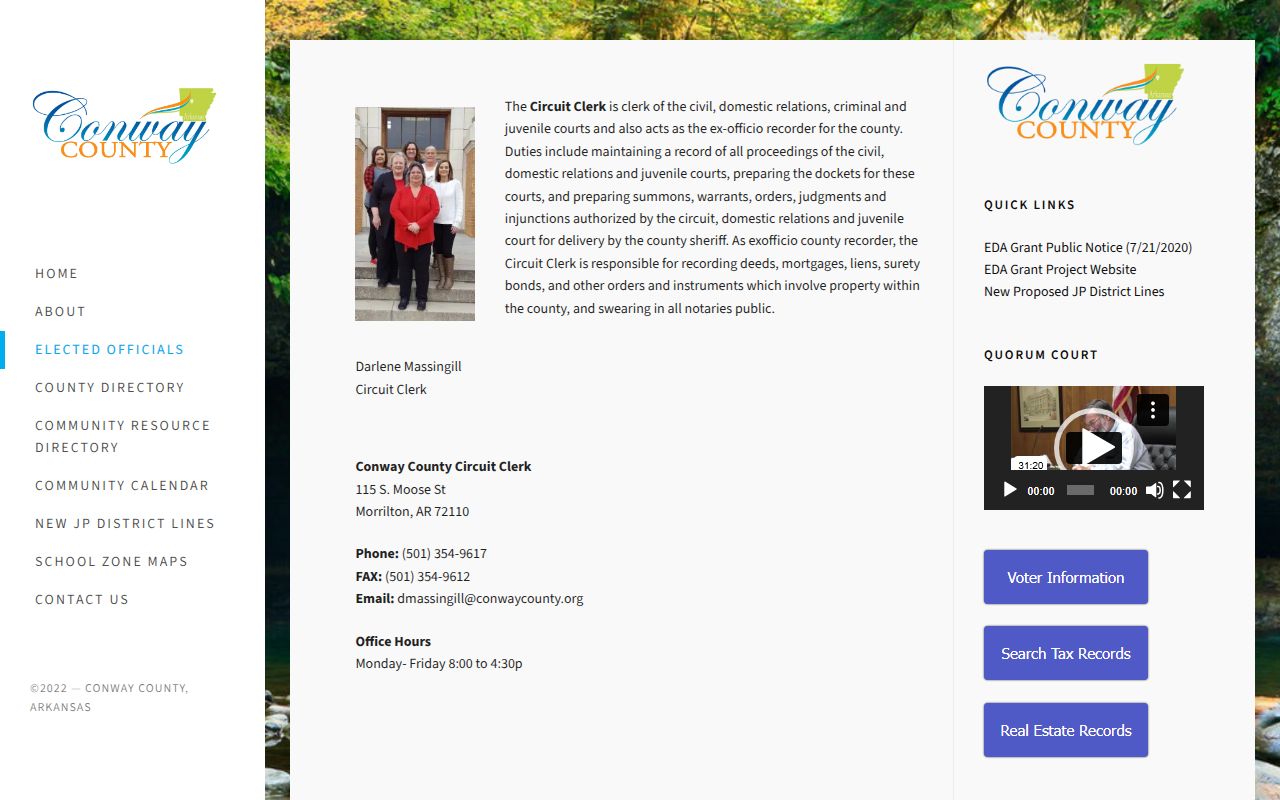
The Conway County Circuit Clerk page describes the recording functions of the office and provides contact details for deed record requests in Morrilton.
Circuit Clerk Duties and Services
The Conway County Circuit Clerk serves two main functions. The first is as clerk of the civil, domestic relations, criminal, and juvenile courts. The second is as the ex-officio recorder for the county, responsible for recording and maintaining all land records. These two roles sit in the same office, which means the clerk's staff handles both court case filings and deed recordings.
On the recording side, the clerk records deeds, mortgages, liens, and surety bonds. Each document is indexed by grantor name and grantee name, assigned a book and page or instrument number, and stored as part of the permanent county record. The clerk also swears in notary publics. This can matter to title researchers because notary records filed with the clerk's office can confirm whether a specific notary was active and commissioned at the time a deed was executed.
The Circuit Clerk's office in Conway County does not currently list a standalone online deed search portal. Deed record searches are done in person at the courthouse or by written request. The ARCountyData tool provides some property data but may not include full deed images for all years. For certified copies of specific instruments, contact the office at (501) 354-9617.
Recording Fees and Requirements
Conway County follows the standard Arkansas recording fee schedule under Arkansas Code § 21-6-306. The fee is $15 for the first page of any recorded instrument and $5 for each additional page. Two-sided documents count as two separate pages. Multiple instruments submitted in a single document each carry their own $15 base fee, though the total is capped at $300 per submission.
The Real Property Transfer Tax applies to most Conway County deed recordings at a rate of $3.30 per $1,000 of stated consideration on transactions over $100. Common exemptions from this tax include transfers between spouses, gifts to close family members, transfers to or from a revocable living trust where the grantor and beneficiary are the same person, and property transfers made as part of a divorce proceeding. The clerk collects both the recording fee and the transfer tax before stamping and indexing the deed.
All documents submitted for recording must be on 8.5 by 11 inch paper. The top right of the first page must have a 2.5-inch blank margin for the recorder's stamp. The bottom of the last page must have a 2.5-inch clear margin. Side and bottom margins on other pages must be at least half an inch. Documents that do not meet these formatting standards may be returned or held.
The first page of every deed must show the document title, the grantor's and grantee's names, and the preparer's name and address. The grantee's mailing address must be on the deed so that property tax statements can be sent to the new owner after the transfer is recorded.
Deeds must be signed in front of two disinterested witnesses or acknowledged by a notary public. Homestead property requires both spouses to sign, even if only one name is on the title. Starting August 5, 2025, individuals filing deeds must show a valid photo ID under Act 752, with exemptions for attorneys, brokers, and bank representatives.
Electronic filing options may be available through vendors such as Simplifile. Confirm current e-recording availability with the Conway County Circuit Clerk at (501) 354-9617.
Historical Conway County Deed Records
Conway County has historical deed records available through FamilySearch. The digitized collection includes deed records from 1825 to 1886, along with a deed and mortgage index covering 1826 to 1925. These older records give researchers access to property transfers from the earliest years of the county's existence. The depth of digitization means you can often trace ownership chains back well into the 19th century without needing to visit the courthouse in person.
Conway County was established in 1825, making it one of the older Arkansas counties. Land records from its earliest years reflect the original survey and settlement of the Arkansas River valley. Some early records may be written in older legal formats that are harder to read without familiarity with 19th century deed conventions. A local title company or genealogical researcher with knowledge of Conway County records can help interpret older instruments.
The Arkansas State Archives Digital Collection also holds land patents and related instruments covering early central Arkansas settlement. For the period before Conway County was formally organized, records would have been filed at the territorial or state level and may require a different search approach.
Note: Researchers tracing title back before 1826 in what is now Conway County will need to look at territorial Arkansas land records and federal General Land Office patent records, which are searchable through the BLM GLO database at no charge.
State-Level Resources for Conway County
The Arkansas Commissioner of State Lands manages tax-delinquent property across all 75 counties. If a Conway County parcel has unpaid property taxes, the COSL may have records showing the delinquency status, any prior auction history, and the current state of ownership. You can check the COSL auction site for current and past Conway County listings.
The Arkansas Judiciary Case Search covers all Arkansas circuit courts including Conway County. Judgment liens, foreclosure cases, and probate proceedings that result in property transfers are searchable through this free tool. Checking for active court cases involving a property is an important part of any title research, and the case search tool makes that step faster and more reliable than it used to be.
For recording statutes that govern all Arkansas counties, the full text is at Arkansas Title 14, Chapter 15. This includes the race-notice recording rule that determines priority between competing deed claimants, the formatting requirements for recorded instruments, and the recorder's statutory duties.