
Monroe County Deed Records Search
Monroe County deed records are maintained by the Circuit Clerk's office at the courthouse in Clarendon, the county seat of this east-central Arkansas county. The Circuit Clerk serves as the ex-officio county recorder and keeps all real property instruments, including deeds, mortgages, liens, plats, and related documents, on file as part of the public record. In-person visits and written fax requests are the primary ways to access deed records in Monroe County.
Monroe County Deed Records
How Deed Recording Works in Monroe County
The Monroe County Circuit Clerk is the ex-officio county recorder for all real property instruments in the county. Every deed, mortgage, lien, deed of trust, plat, power of attorney, and similar instrument affecting title to Monroe County land must be filed through this office. When a document is submitted, the clerk stamps it with the filing date and time, assigns an instrument number, and indexes it by grantor and grantee names. The grantor-grantee index is what allows someone to trace property ownership back through the full chain of title.
Under Arkansas Code § 14-15-404, recording a deed with the county recorder gives constructive notice to all future buyers and creditors from the moment it is filed. Arkansas is a race-notice state. If two parties both claim interest in the same property, the one who records first without knowing about the other's claim generally has the stronger legal position. This is why recording immediately after a closing is standard practice. A delay between signing and recording creates a gap that most real estate professionals close the same business day.
Monroe County is in the Arkansas Delta region along the White River. The county includes extensive agricultural land and natural areas tied to the Cache River watershed and Bayou DeView. Property transactions here involve farm land, hunting tracts, and rural residential parcels as well as a small amount of commercial activity centered in Clarendon. The median home value in Monroe County is around $85,550, and residents pay a median property tax rate of about 0.55 percent.
Monroe County's Circuit Clerk office does not list an online portal for deed record searches. Access to records requires an in-person visit to the Clarendon courthouse or a written request sent by fax. Remote requests submitted by fax with the required documentation and payment are the preferred method for non-local requestors. The fax number for requests is (870) 747-3710.
Monroe County Circuit Clerk Contact
The Monroe County Circuit Clerk is Alice Smith. The office is located at 123 Madison Street, Clarendon, AR 72029. The main phone number is (870) 747-3615. The fax line for document requests is (870) 747-3710. Office hours are Monday through Friday during regular business hours. For remote requests, fax your request with the required documentation and fees to (870) 747-3710. Include the document type, grantor and grantee names, approximate date range, and any instrument number or legal description you have.
For mail-in requests, send to the street address above. Include a self-addressed stamped envelope and prepay for copy fees. The standard copy fee is $0.50 per page. Certified copies run $5.00 per document. Allow extra time for mail requests compared to in-person visits. For urgent needs, visiting in person or using the fax request method is the faster option in this county.
The Arkansas recording statutes reference page shown below provides the legal framework that governs deed recording procedures in Monroe County and every other Arkansas county.
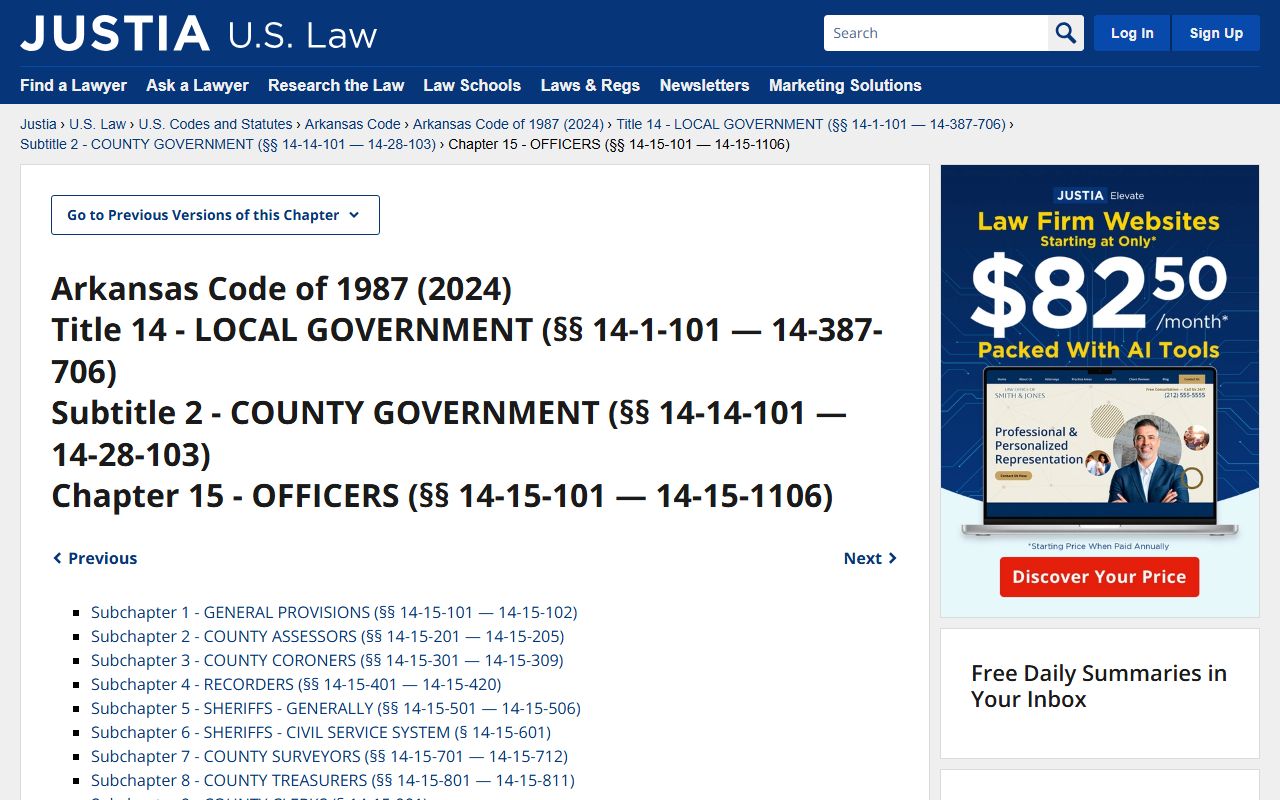
The Arkansas recording statutes at Title 14, Chapter 15 cover deed formatting requirements, the recorder's duties, and how recorded instruments provide constructive notice. These rules apply to Monroe County deed recording the same as every other county in the state.
Online Resources for Monroe County Deed Research
Monroe County does not offer an online deed record search portal. The primary access method is in-person at the Clarendon courthouse or by written fax request. For online research support, the ARCountyData Monroe County page provides free assessor-linked property data searchable by owner name, parcel number, or address. While it does not replace the deed index, it gives ownership and parcel information that helps identify the correct record to request from the clerk's office.
The Arkansas Judiciary Case Search covers Monroe County court records including judgment liens, foreclosure actions, and probate proceedings affecting property title. These court records don't appear in the deed index but can significantly affect ownership and encumbrance status. Running a case search alongside the deed index check is good practice, especially for agricultural parcels that may have been subject to lender actions or estate proceedings over the years.
For properties near the White River or Cache River bottoms, checking with the U.S. Army Corps of Engineers for any flowage easements or flood control easements is worth doing as a supplemental step. These federal easements affect agricultural use of bottomland and occasionally appear in deed records as well as federal agency records. The Arkansas State Land Surveyor's online plat retrieval tool at plat.arkansas.gov also helps confirm survey boundaries for delta parcels.
Recording Fees and Document Requirements
Monroe County follows the state fee schedule under Arkansas Code § 21-6-306. The recording fee is $15.00 for the first page and $5.00 for each additional page. A two-sided document counts as two pages. Documents listing multiple instruments carry an additional $15.00 per instrument beyond the first. The Real Property Transfer Tax is $3.30 per $1,000 of consideration on transactions over $100. The clerk collects this at recording. Exempt transfers include family gifts, spousal transfers, trust transfers, and divorce property divisions.
Document formatting requirements apply statewide under Arkansas Code § 14-15-403. Paper must be 8.5 x 11 inches with a 2.5-inch blank margin at the top right of the first page. Side and bottom margins on all pages must be at least half an inch. The last page must have a 2.5-inch bottom margin. The first page must identify the document title, grantor, grantee, and preparer. Deeds must be signed before two disinterested witnesses or acknowledged before a notary public under Arkansas Code § 18-12-104. Homestead conveyances require both spouses to sign regardless of whose name appears on title.
Act 752, effective August 5, 2025, requires any individual filing a deed in person to present a valid government-issued photo ID. Attorneys, brokers, bank representatives, and government employees are exempt from this rule.
Historical Monroe County Deed Records
FamilySearch holds historical Monroe County deed records going back to 1830. The collection includes deeds with an index covering 1830 to 1941 and 1830 to 1905. A Surveyor's Record, Volume A from 1898 and a plat book are also in the collection. Monroe County's deed history reflects the conversion of delta swampland into productive agricultural land through drainage and reclamation projects that happened across the lower White River watershed in the late 1800s and early 1900s. Those early conveyances often involved large tracts that were later subdivided into the farm parcels that exist today.
For research on the original swamp land grants and state land patents, the Arkansas State Archives Digital Collections are the right place to start. Monroe County was one of the counties where the federal government transferred swamp land to the state of Arkansas under the Swamp Lands Acts, and those transfers are documented in the state archives. The Bureau of Land Management's General Land Office Records portal also covers original federal land patents for this area. Together, these resources let researchers trace land ownership back to the original public land survey and first private ownership of any Monroe County parcel.
State Resources Supporting Monroe County Research
The Arkansas Commissioner of State Lands manages tax-delinquent property records for Monroe County. When property taxes go unpaid and are certified to the state, COSL begins a notice and auction process. Check upcoming Monroe County tax sales at auction.cosl.org. Buyers at COSL auctions receive a limited warranty deed from the state. The COSL parcel maps help identify specific parcels and confirm location before bidding.
E-recording vendors serving Arkansas counties statewide include Simplifile, CSC eRecording Solutions, eRecording Partners Network, and Indecomm Global Services. E-filing allows same-day confirmed recording without a trip to Clarendon. Since Monroe County is a smaller rural county without a convenient location for many out-of-area professionals, e-recording is an especially practical option for attorneys and title companies handling Monroe County transactions remotely.
The Arkansas State Land Surveyor's Office provides free access to original survey plats and corner certificates through the plat retrieval tool at plat.arkansas.gov. For delta county parcels with complex drainage district histories, checking survey records alongside deed records gives a more complete picture of boundary history. The Arkansas Secretary of State handles entity verification for companies or trusts appearing as parties in Monroe County deed instruments.
The COSL tax auction site shown below is an important resource for Monroe County property research, particularly for parcels with potentially complex tax histories.
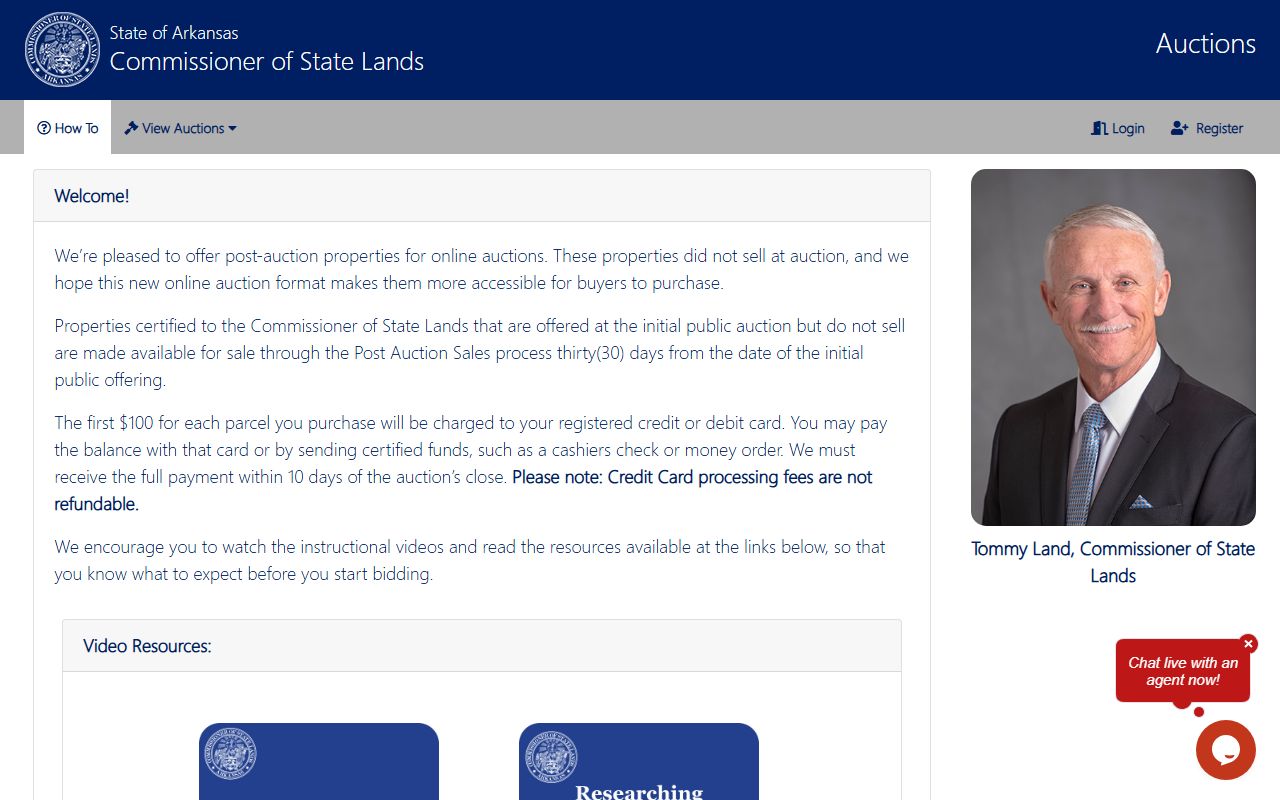
The COSL auction portal at auction.cosl.org provides information on tax delinquent properties in Monroe County and all of Arkansas, with upcoming auctions, past results, and parcel mapping tools available to the public.