
Find Prairie County Deed Records
Prairie County deed records are filed with the Circuit Clerk's office in Des Arc, Arkansas. Prairie County is unique among Arkansas counties in that it has two county seats: Des Arc and DeValls Bluff. All property transfers, mortgages, and liens for land in Prairie County are kept by the Circuit Clerk and available as public records. This page covers how to access those records, what fees apply, and where to find additional property research tools.
Prairie County Deed Records Overview
How to Access Prairie County Deed Records
Prairie County is one of only two Arkansas counties with two county seats. The Circuit Clerk's main office is at 200 Courthouse Square, Des Arc, AR 72040. There is also an office in DeValls Bluff. The clerk and county clerk is Gaylon Hale. Phone: (870) 256-4434. The main email address is prairieclerk@arkansasclerks.com. You can request documents by fax at (870) 256-4434 or (870) 998-2010 for the DeValls Bluff location.
Prairie County does not have a centralized online platform for remote deed record access. In-person visits to the Circuit Clerk's office in Des Arc are the primary method for researching property records. The main office is at Suite 104 at 200 Courthouse Square in Des Arc. If you cannot visit in person, mail requests and fax requests are accepted. Include a self-addressed stamped envelope with any mail request for copies.
The Prairie County Service Portal provides an online access point for county property data and county services. This portal is the best starting point for online research into Prairie County property records. The screenshot below shows this portal interface.
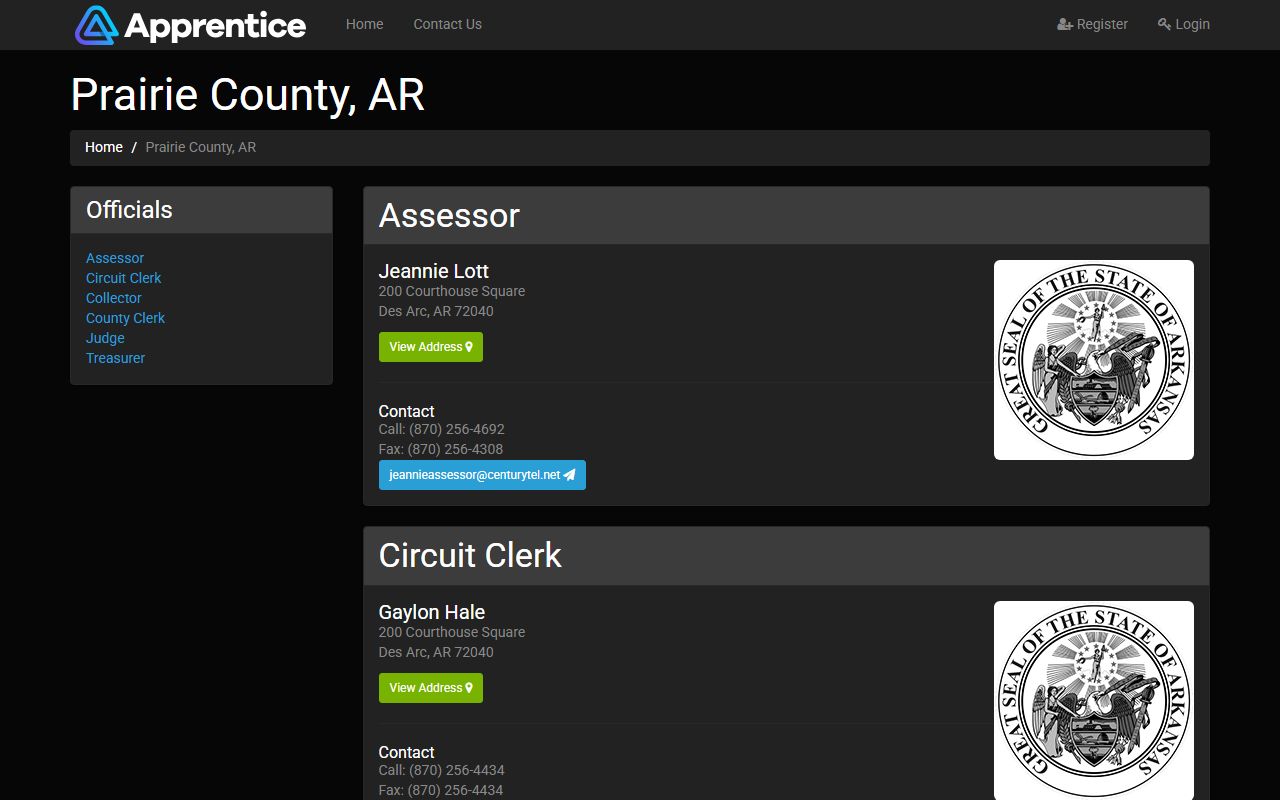
The Prairie County Service Portal provides online access to county property records, assessment data, and other official county services for Prairie County, Arkansas.
Prairie County Circuit Clerk and County Officials
Circuit Clerk and County Clerk Gaylon Hale maintains the deed records for Prairie County. The clerk's office is at 200 Courthouse Square, Des Arc, AR 72040. Phone: (870) 256-4434. Email: prairieclerk@arkansasclerks.com. The two-courthouse setup means that some county services are split between Des Arc and DeValls Bluff, depending on the district. Contacting the clerk's office before your visit will help you know which location handles the records you need.
County Assessor Jeannie Lott handles property valuations and parcel maps. Phone: (870) 256-4692. Fax: (870) 256-4308. Email: jeannieassessor@centurytel.net. County Collector Rick Hickman handles property tax billing. Phone: (870) 256-4137. Fax: (870) 256-3367. Email: prairiecountycollector@centurytel.net. County Judge Mike Skarda can be reached at (870) 256-3741. County Treasurer Tamara Dabney is at (870) 256-4786.
All deed records for Prairie County land are indexed by grantor and grantee name. You can trace the chain of title forward or backward from any known owner using the name index. Some older records may be in bound deed books, while more recent instruments are likely in a digital system. Contact the clerk's office to find out what format is available for the time period you are researching.
Prairie County sits in the Arkansas Delta region. Much of the county is flat agricultural land along the White River and its tributaries. Farmland ownership in this area can involve complex arrangements, including undivided interest deeds shared among family members over multiple generations. When researching Prairie County deed records, be prepared to trace multiple generations of transfers and look for any drainage district easements or agricultural liens that may affect farmland parcels.
Recording Fees and Requirements in Prairie County
Prairie County recording fees follow the state schedule under Arkansas Code § 21-6-306. The fee is $15 for the first page of any instrument and $5 for each additional page. Two-sided pages count separately. Multiple instruments in one document may carry separate base fees. The Real Property Transfer Tax of $3.30 per $1,000 of sale price applies to most transactions over $100.
Common transfer tax exemptions apply in Prairie County just as throughout Arkansas. Gifts between spouses or close family members, transfers to or from a living trust, and certain divorce-related transfers are exempt. If your transaction qualifies for an exemption, note the basis for the exemption on the deed before filing. The clerk collects the tax at the time of recording if it applies.
All documents filed in Prairie County must meet the Arkansas formatting rules. Paper must be 8.5 by 11 inches. The top right of the first page needs a 2.5-inch blank margin for the recorder's stamp. Side margins are at least half an inch throughout. The last page requires a 2.5-inch blank bottom margin. The first page must include the document title, grantor and grantee names, and the preparer's name and address. Deeds must be signed before a notary public or two disinterested witnesses.
Under Arkansas Act 752, effective August 5, 2025, individuals filing deeds in Prairie County must present valid photo ID. Licensed attorneys, real estate brokers, bank representatives, and government employees in official roles are exempt.
What Records Are Kept in Prairie County
The Prairie County Circuit Clerk records warranty deeds, quitclaim deeds, special warranty deeds, mortgages, deeds of trust, release deeds, powers of attorney, plats, and survey plats. The office also records mechanic's liens, federal and state tax liens, lis pendens notices, and other instruments that can affect the title to property in Prairie County. A complete title search must check each of these instrument types across the full ownership history of the parcel.
Plat maps are recorded by the Circuit Clerk when land is subdivided in Prairie County. Under Arkansas Code § 14-18-101, a certified plat must be filed with the recorder of deeds and a copy goes to the county assessor. Lots in any Prairie County subdivision cannot have a complete legal description without referring to the recorded plat. Checking the plat is an essential step in any deed research for subdivided land.
Prairie County was formed in 1846. The county's deed records go back to that era. Some older records may be on microfilm or in bound deed books at the courthouse. For records from the 1800s and early 1900s, in-person research is the most reliable method. FamilySearch has digitized some older Prairie County deed books that may be accessible online for historical research.
State Resources for Prairie County Property Research
The Arkansas Commissioner of State Lands handles tax-delinquent properties in Prairie County. COSL records and parcel maps show the tax status of properties across the county. You can browse past and upcoming auctions at auction.cosl.org. Buyers at COSL auctions receive a limited warranty deed from the Commissioner of State Lands.
The Arkansas Judiciary Case Search covers circuit court cases in Prairie County including foreclosures, judgment liens, and probate proceedings. Court records that affect property title appear here and must be checked alongside the deed index for a thorough title search.
For historical deed research, the Arkansas Digital Archives holds collections of early Arkansas land records. FamilySearch digitized deed books can supplement the courthouse records for older research. When researching farmland in Prairie County, also check the Agricultural Stabilization and Conservation Service records through the USDA Farm Service Agency, which can document agricultural program easements on specific parcels.
Business entities holding Prairie County property can be verified through the Arkansas Secretary of State. Certified entity records confirm whether an LLC or corporation is authorized to do business in Arkansas and has the authority to convey real property.
Nearby Arkansas Counties
Prairie County is in central-eastern Arkansas in the White River Delta region. Deed records for neighboring counties are held by their respective Circuit Clerks.